 YouTube Dislike Counter
 YouTube Like to Dislike Ratio: How to Read It
A raw dislike number tells you less than you think. Forty thousand dislikes is catastrophic on a small channel and unremarkable on a video with twenty million views. The YouTube like to dislike ratio is the figure that actually travels between videos of different sizes — here is how to read it, and how to check it.
What the ratio measures
The ratio expresses dislikes as a share of all votes, usually shown as the percentage that were likes:
likes ÷ (likes + dislikes) × 100
A video with 46 million likes and 21 million dislikes scores about 68% — visibly divisive. A video with 700,000 likes and 4,000 dislikes scores 99.4% — an audience that agreed with itself. Both statements survive the fact that neither dislike figure is exact.
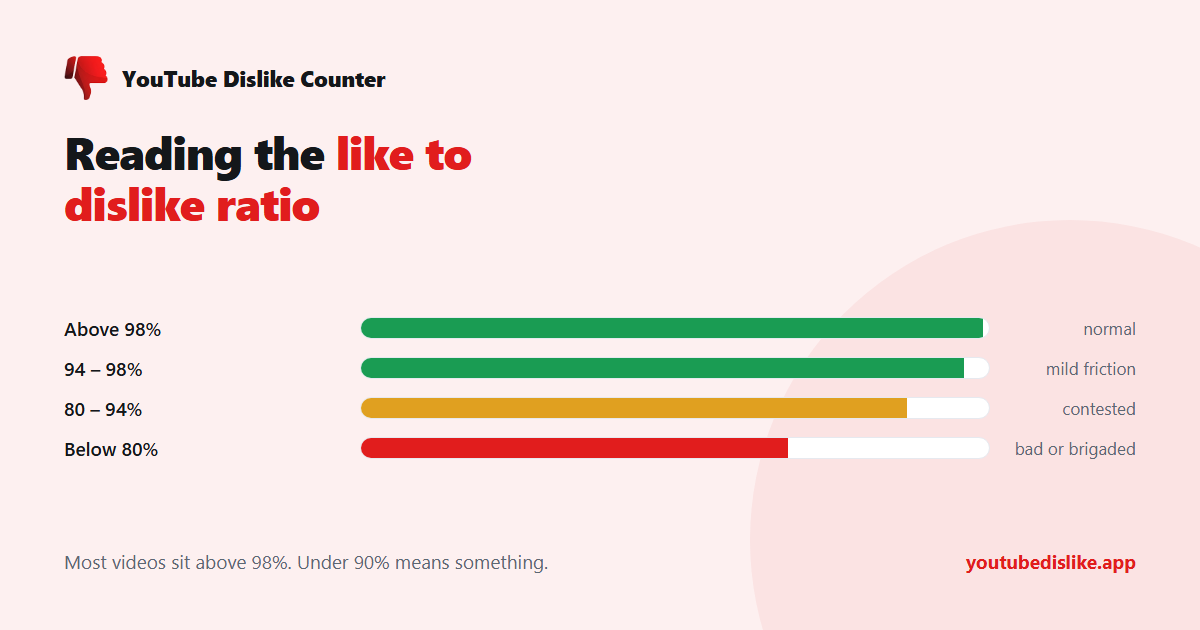
How to read a ratio
| Ratio | What it usually means |
|---|---|
| Above 98% | Normal. Most videos sit here; the audience is self-selecting. |
| 94–98% | Mild friction — a tutorial that did not work for everyone. |
| 80–94% | Genuinely contested. Worth reading the comments before trusting it. |
| Below 80% | Either a bad video or an organised campaign. Both are worth knowing. |
The important calibration: on YouTube, likes hugely outnumber dislikes on almost everything, because people who dislike a video usually just leave. A 95% ratio is not a good score — it is a slightly worrying one.
How to check the ratio for any video
Paste a video link into our dislike checker. It shows the estimated dislike count and the percentage of votes that were likes, with a bar so the split is readable at a glance. Nothing to install, and it works on a phone.
If you would rather have it appear automatically as you browse, the free YouTube dislike extension puts the dislike count back into YouTube’s own button row, next to the like count that is still public — so the comparison is right there on every video.
Why we show the percentage rather than the like number
The like figure available to any third-party tool lags YouTube’s live one, sometimes by thousands on a busy video. That is a number you could check against YouTube and catch being wrong. The ratio does not have that problem: a one percent drift in likes moves the percentage by about a hundredth of a point.
The ratio YouTube used to show
For years there was a thin bar under the like and dislike buttons, split in proportion to the two counts — exactly this calculation, drawn instead of written. A bar like that would have given the ratio away, so it went when the count went private in November 2021.
Its disappearance is part of why the change landed so hard. The bar had trained a generation of viewers to glance at a proportion rather than read a number, and that habit had nowhere to go once both were gone. For the background, see why YouTube removed the dislike count.
Ratio versus raw count: a worked example
| Video A | Video B | |
|---|---|---|
| Likes | 4,000 | 2,100,000 |
| Dislikes | 1,200 | 40,000 |
| Raw dislikes | Looks fine | Looks alarming |
| Ratio | 76.9% | 98.1% |
Video B has thirty times as many dislikes and is doing far better. Reading raw counts across videos of different sizes gets this backwards almost every time, which is the entire argument for the ratio.
Where the ratio is unreliable
- New videos. With few recorded votes, the percentage swings wildly. Give it time.
- Small channels. A handful of votes cannot produce a meaningful share.
- Brigaded videos. The ratio is real but reflects a campaign, not the content.
Frequently asked questions
Is the ratio the same as the old red bar?
It is the same idea. YouTube used to show a thin bar under the like and dislike buttons representing exactly this split.
Does a low ratio hurt a video’s ranking?
YouTube has said dislikes were never a major ranking signal. Watch time and satisfaction matter far more — see what a dislike still does to a video.
Can creators see their true ratio?
Yes. YouTube Studio reports exact likes and dislikes for your own videos, so your ratio there is real rather than estimated. Where creators find their own dislikes covers the exact menus.
Why do two tools show slightly different ratios?
Different dislike estimates produce slightly different percentages. On a video with a large vote count the difference is usually a fraction of a point.
To summarise: the YouTube like to dislike ratio is the number worth looking at, because it means the same thing on a video with a thousand views and one with a hundred million. Check any video in seconds with our dislike checker.
+ Chrome + Edge + Firefox YouTube Dislike Checker →
YouTube is a trademark of Google LLC. This website and the extension are independent projects and are not affiliated with, endorsed by, or sponsored by Google LLC or YouTube. The trademark is used only to describe compatibility.