 YouTube Dislike Counter
 Why YouTube Removed the Dislike Count
In November 2021 the number under every video quietly disappeared. If you have been wondering why YouTube removed the dislike count from public view — and whether it is ever coming back — here is what actually happened, in order, with what YouTube said at each step.
What YouTube changed, and when
The dislike button never went anywhere. You can still press it, and your vote still counts toward the private figure the uploader sees. What disappeared was the public number next to it.
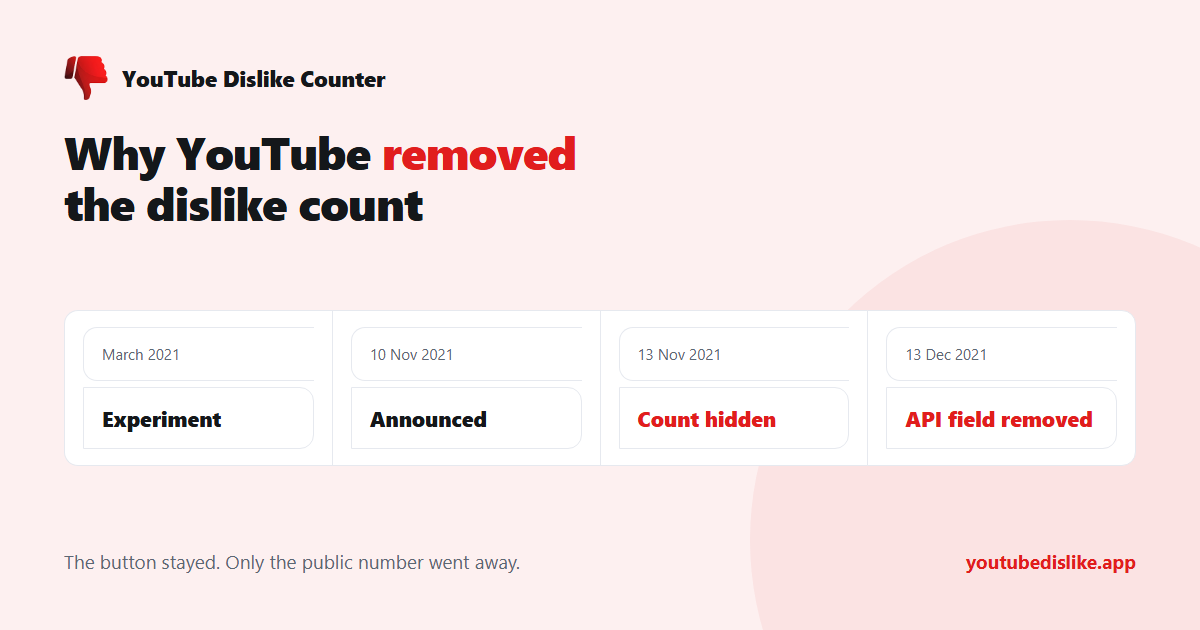
| Date | What changed |
|---|---|
| March 2021 | YouTube runs a limited experiment hiding the count for some viewers |
| 10 November 2021 | Announces the count is going private for everyone and starts the rollout the same day |
| Following days | The public count disappears across the platform as the rollout completes |
| 13 December 2021 | The dislikeCount field in the Data API becomes private — returned only to the video’s owner |
That last date matters more than people realise. Until December 2021 anyone could still read the number programmatically. After it, the only remaining public record was whatever third parties had already archived. Both dates come from YouTube itself: the announcement on the official YouTube blog and the Data API revision history.
The reason YouTube gave
YouTube’s stated motivation was protecting creators from harassment and from what it called dislike attacks — co-ordinated groups piling dislikes onto a video to bury it. The company said its experiment showed that hiding the count reduced this behaviour, because there was no visible scoreboard to run up.
It also framed the change as a wellbeing measure: a new creator watching a public dislike number climb is a specific kind of discouraging, and YouTube argued fewer people would quit early without it.
What critics said
- The dislike ratio was a fast, language-independent quality filter — useful for spotting tutorials that do not work or downloads that are not safe.
- YouTube published no data alongside the claim, so the experiment’s results could not be checked by anyone outside the company.
- Large channels and corporate uploads benefited most, since they attract the most visible disapproval.
What still exists today
Three things survived the change, and they are the reason a dislike count can still be shown at all:
- The uploader’s own figure. Creators still see exact dislikes for their own videos in YouTube Studio analytics.
- The archive. Projects that were collecting public counts before November 2021 kept what they had gathered.
- Extension votes. People using dislike extensions today contribute their own votes, which keeps estimates moving.
Combine the archive with live votes and you get an estimate — close for popular older videos, rough for anything new or small. That is the honest description of every dislike counter available now, including ours.
Is the count coming back?
There has been no indication that YouTube intends to restore it. The API field remains private, the button remains counted-but-private, and the company has not revisited the decision publicly since the rollout. We look at the recurring rumours, and what would have to change, in is the YouTube dislike count coming back?
Frequently asked questions
Did YouTube delete the dislikes themselves?
No. Votes are still recorded and still shown to the uploader. Only the public display was switched off.
Can I still dislike a video?
Yes. The button works exactly as it did; you simply cannot see the total any more.
Does hiding dislikes affect the algorithm?
YouTube has said dislikes were never a large ranking factor. What changed was visibility, not how recommendations are calculated.
How can I see dislike counts now?
Either paste a link into a dislike checker, or install a YouTube dislike extension that puts the estimated number back into YouTube’s own like/dislike bar as you browse.
The short version: YouTube removed the dislike count from public view in November 2021 to discourage co-ordinated dislike campaigns, and pulled it from the API a month later. The votes still exist — they are just private now, which is why every public figure you see today is an estimate built from archived data and current extension users.
+ Chrome + Edge + Firefox YouTube Dislike Checker →
YouTube is a trademark of Google LLC. This website and the extension are independent projects and are not affiliated with, endorsed by, or sponsored by Google LLC or YouTube. The trademark is used only to describe compatibility.