 YouTube Dislike Counter
 Are YouTube Dislike Counts Accurate?
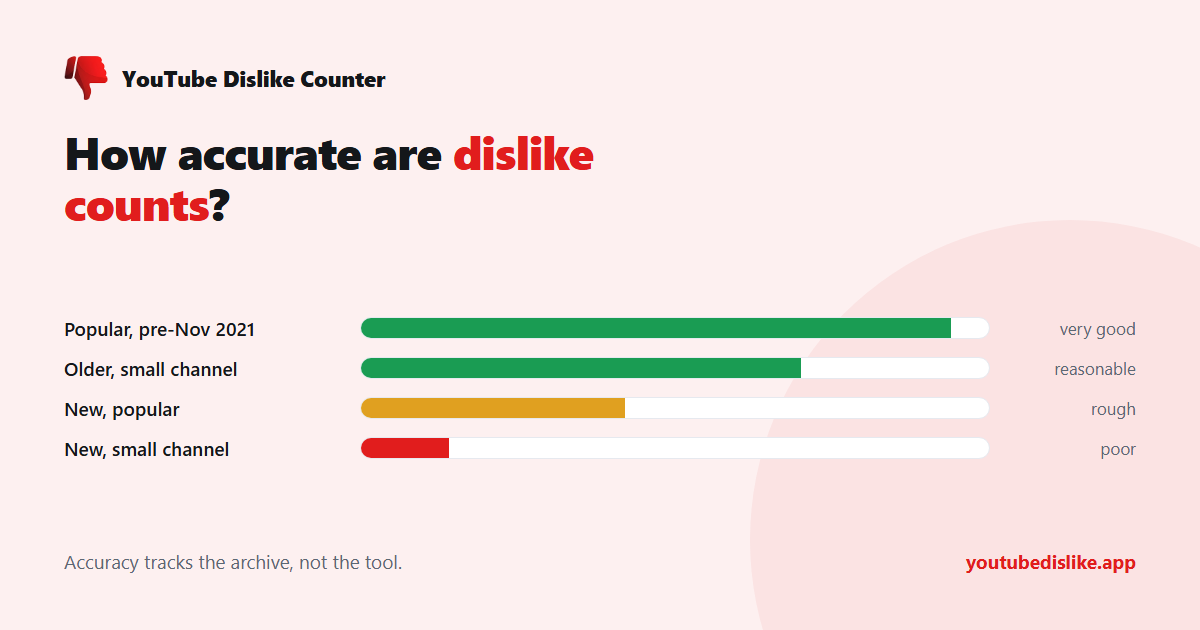
Every tool that shows dislikes today is showing an estimate, and anyone telling you otherwise is guessing or selling something. So how accurate are YouTube dislike counts in practice? The honest answer depends almost entirely on one thing: when the video was published.
Where the numbers come from
Since YouTube made the figure private in November 2021, no public tool can read the real number. What they can do is reconstruct it from two sources:
- An archive. Public counts were being collected while they were still visible. For a video that existed before the change, that archive holds a real, recorded figure.
- Live votes. People running a YouTube dislike extension today report their own votes, which keeps the estimate moving after the archive stopped.
Neither source sees YouTube’s private total. Together they approximate it — well in some cases, poorly in others.
How accurate, by video type
| Video | Accuracy | Why |
|---|---|---|
| Popular, published before Nov 2021 | Very good | Archived from the real public number, huge sample |
| Older but small channel | Reasonable | Archived, but a smaller base to extrapolate from |
| Published after Nov 2021, popular | Rough | No archive at all; extrapolated from extension users only |
| New upload, small channel | Poor | Few or no votes recorded — may show near zero |
That table is the whole story. A ten-year-old music video with millions of votes will be close. A video uploaded last week on a channel with 200 subscribers may show almost nothing, and that is not a bug — there is simply nothing recorded for it yet.
Why extrapolation is needed at all
Only a fraction of viewers run a dislike extension. If a video gets 100 real dislikes and three of them come from extension users, a tool that reported “3” would be useless. So the raw votes are scaled up using the ratio observed on videos where the true number is known from the archive.
This works because the sample is large and reasonably random. It breaks down where the sample is tiny — which is exactly the new-and-small case in the table above.
What can make an estimate drift
- A video that suddenly goes viral gains real dislikes faster than extension users can register them.
- Audiences differ: a technical audience runs more extensions than a general one, which skews the scaling factor.
- Deleted or privated videos freeze at their last known figure.
The one number that is exact
If you uploaded the video, you do not need any of this. Open YouTube Studio, go to Analytics, and the real dislike count for your own videos is reported there — the actual figure, not an estimate. That is the only place an exact number is still available to anyone.
How to read a dislike figure sensibly
Treat it as a signal, not a measurement. A video showing 40,000 dislikes against 50,000 likes is telling you something real about how it landed, and the exact digits do not change that conclusion — which is why the like-to-dislike ratio is usually the more useful figure. A brand-new video showing 2 dislikes is telling you nothing at all.
Frequently asked questions
Why do two dislike extensions show different numbers?
They may use different archives, different vote pools, or different scaling. Small differences between tools are expected; large ones usually mean one of them has no data for that video. Running both at the same time causes its own problems — see why two dislike extensions at once break the display.
Does the estimate update over time?
Yes. As more people vote and the figure is refreshed, it moves. A number you saw last month may be slightly different today.
Can a dislike count be zero?
It can genuinely be zero, and it can also mean “no data”. A good tool distinguishes the two — ours says so explicitly rather than printing a misleading 0.
Is the like count accurate?
Likes are still public on YouTube, so the authoritative figure is the one YouTube itself displays on the page.
To sum up: YouTube dislike counts shown by any public tool are close estimates for popular pre-2021 videos and increasingly rough for anything newer or smaller. You can check any video with our dislike checker — just read the result with the video’s age in mind.
+ Chrome + Edge + Firefox YouTube Dislike Checker →
YouTube is a trademark of Google LLC. This website and the extension are independent projects and are not affiliated with, endorsed by, or sponsored by Google LLC or YouTube. The trademark is used only to describe compatibility.